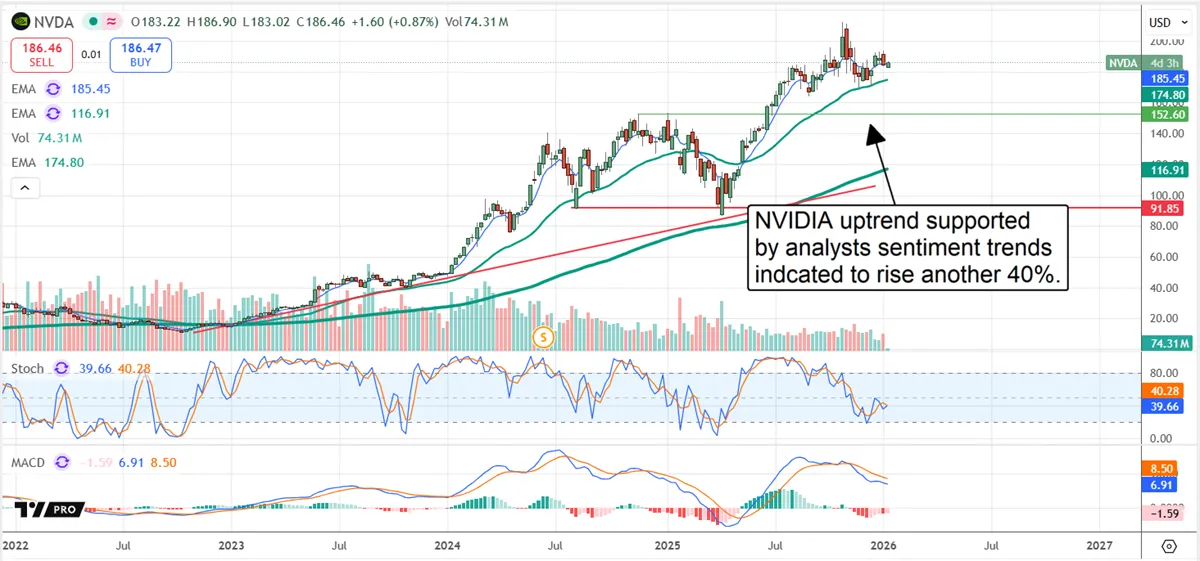
The equity of Nvidia has improved at a considerable pace, escalating by about half in the past year, a trend that has been linked to its superiority in the emerging artificial-intelligence industry.
In fiscal year 2026, fourth quarter, the firm had a revenue growth of US$68.1 billion, an increase of 73% year to year, and an adjusted earnings per share of US1.62 as compared to the projected US1.52. The question is then what is going to stimulate the next multibillion-dollar growth.
Record Momentum Builds
It is not the first time Nvidia has developed it. The company has already achieved 11 times 50% profits in two months, which can be compared to major increments in 2016 and 2024.
During the twelve months that followed, the revenue growth continued, where it stood at 65.2% and an average of 91.6% over the three years, which is supported by its free-cash-flow margin of 49% and price-to-earnings ratio of 48, which is a premium value as the online market dominates.
NVIDIA has an effect that is not limited to the manufacture of hardware; it is the backbone of the artificial-intelligence economy, as the analyst team at Treis keeps track of the transformation that the company is going through: it is no longer about manufacturing game processors but rather a data-center powerhouse.
Three Catalysts That Change the Game
1. First, sovereign artificial-intelligence projects are expanding rapidly: Nvidia is expected to secure over $30 billion in contracts by fiscal year 2026 with countries including Canada, France, the Netherlands, Singapore, and the United Kingdom. These projects broaden Nvidia’s revenue streams beyond cloud hyperscales.
Second, through ARM-based system-on-chip solutions, Nvidia will enter the consumer-AI personal-computer market by mid-2026; longtime Nvidia affiliates like Dell and Lenovo have already pre-cooked laptops that could tap an emerging multibillion-dollar opportunity and possibly eliminate reliance on data-center deployments.
Third, considerable strategic investments such as a rumored US30 billion investments in OpenAI and the acquisition of AI21 Labs support the aim of Nvidia taking control of things running in the ecosystem.
Risks Lurk in the Shadows
The pitfalls should be disregarded. Signs of deteriorating working-capital balances would be evidence of channel-stuffing; the weakness of sales in China caused by regulatory limitations; and continued patent disputes would be dangerous to core technologies. The history of the 6% drop during the dot-com crash and that of the financial crisis of 85% are warning signs of possible declines.
Bright Horizon Ahead
Analysts look forward to an additional 30 -50% rally in case the said catalysts occur. As forecasts report that possible spending on artificial-intelligence infrastructure around the world is projected to grow to more than US$200 billion by year-end, according to the recent Gartner data dated February 23, 2026, the Nvidia competitive moat has been shown to be strong.
Advanced investors see market declines as an acquisition point and place themselves to take advantage of the perceived artificial-intelligence wave in 2026.